
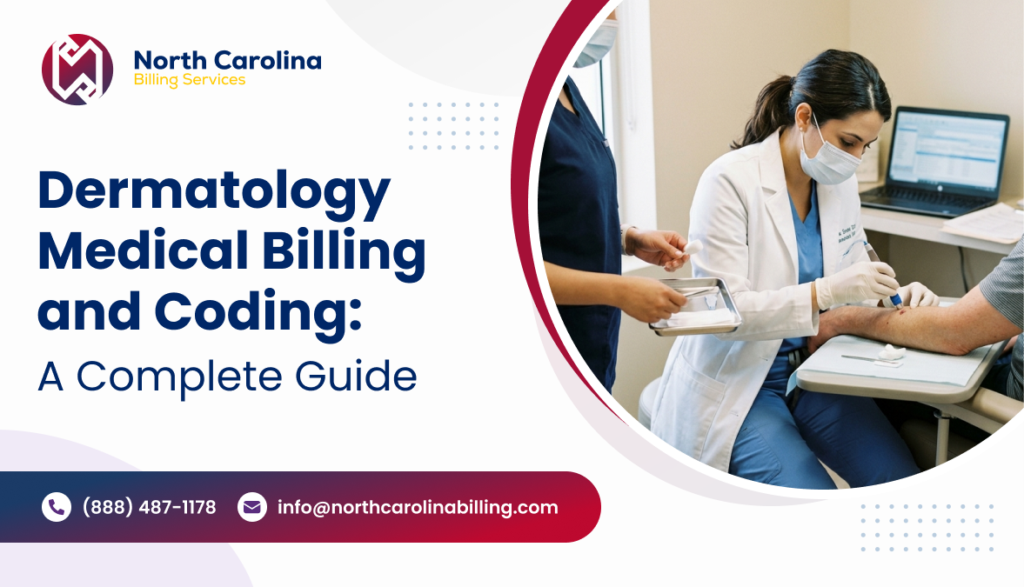
In one single visit, a dermatologist performs a skin biopsy and surgically removes several actinic keratoses as well as evaluates the issue of eczema of the patient. Though this may seem as a simple clinical process, this statement involves many coding problems which have to be resolved. The practice needs to choose the appropriate codes of procedures performed, document all the lesions and find out whether it can get paid for the office visit.
Medical billing and coding for dermatology services is the process of selecting appropriate codes for skin treatment, diagnostics and surgery services. It entails abiding by the rules of the payer and also the necessity of procedures performed by the dermatologist.
Wrong documentation on the lesion measurement, biopsy type, and modifiers used may cause claim denial and hence non-reimbursement of claims.
The paragraphs below outline some of the dermatology billing codes, documentation challenges, and coding challenges as well as ways to protect your money flow.
What Makes Dermatology Medical Billing Different?
A dermatology office provides a wide variety of services such as treating acne, psoriasis, doing a diagnostic biopsy, removing lesions, and dealing with skin cancers.
Many visits also require multiple treatments at once. The doctor can remove several lesions, do a biopsy on one that is concerning, and check out a completely different skin problem.
Each service creates specific billing requirements.
For example, the code for excision depends on the location and size of the lesion, while the code for destruction can depend on the number and classification of the lesions.
In addition, a charge for the additional visit to the clinic will require evidence of additional time and effort required for the examination and treatment as opposed to the usual process.
The coding of dermatologic procedures needs to factor in these differences and comply with the CPT, ICD-10-CM, Medicare NCCI edits, among others.
Common Dermatology CPT Codes Every Practice Should Know
CPT codes stand for the medical procedures and treatment services offered by physicians. Selecting the CPT codes necessitates careful thought about the technique, medical indication, body part involved, and documentation.
CPT Codes for Skin Biopsy
Skin biopsy allows dermatologists to diagnose abnormal skin lesions and inflammation among other skin conditions.
Coding depends on how the skin tissue is removed from the patient.
| CPT Code | Procedure |
| 11102 | Tangential biopsy, first lesion |
| +11103 | Each additional tangential biopsy |
| 11104 | Punch biopsy, first lesion |
| +11105 | Each additional punch biopsy |
| 11106 | Incisional biopsy, first lesion |
| +11107 | Each additional incisional biopsy |
However, the coding of additional lesions is governed by the reporting guidelines of CPT. Clinicians must first decide the proper primary code along with add-on code when more than one technique is utilized to perform a biopsy procedure.
For instance, a tangential biopsy of the suspect lesion of face is performed by a dermatologist and then he conducts a punch biopsy on a different lesion on the patient’s back.
Both the sites of the procedures and the biopsy technique employed on each site need to be documented as per the guidelines of CPT. In addition, there is a difference between a diagnostic biopsy and a shave removal procedure.
Lesion Destruction CPT Codes
Cryotherapy or other similar treatments are commonly used by dermatologists to remove premalignant and benign lesions.
This requires accurate lesion counts.
| CPT Code | Common Application |
| 17000 | First premalignant lesion |
| +17003 | Each additional premalignant lesion, lesions 2–14 |
| 17004 | Destruction of 15 or more premalignant lesions |
| 17110 | Destruction of 1–14 qualifying benign lesions |
| 17111 | Destruction of 15 or more qualifying benign lesions |
Example of billing: A physician removes six actinic keratoses through cryosurgery.
Where the documentation justifies the use of this family of codes, a practice usually uses CPT 17000 for the first lesion and 17003 with 5 units as an add-on code.
When the number of lesions destroyed by the physician is 15 or more, CPT 17004 is the correct code for this procedure.
Wrong numbers of lesions, wrong number of add-on units, and confusion between benign lesions and premalignant lesions may result in preventable claims issues.
Shave Removal and Lesion Excision Codes
A skin biopsy, shave removal, and surgical excision are not interchangeable services.
| Procedure | CPT Code Family | Key Coding Factor |
| Shave removal | 11300–11313 | Location and lesion diameter |
| Benign lesion excision | 11400–11446 | Location and excised diameter |
| Malignant lesion excision | 11600–11646 | Location and excised diameter |
Excision codes generally require the diameter of the lesion plus the clinically necessary margins.
For example, a lesion measuring 0.9 cm with 0.2 cm margins on each side produces a total excised diameter of 1.3 cm.
The physician should document this measurement before removing the lesion.
The operative report should also include the description of the anatomic location, technique of removal, indication for surgery, and repair if any.
Simple closure is usually included in the lesion removal reimbursement. Intermediate to complex repairs can be coded separately if indicated by the situation.
Important: A dermatologist cannot choose the malignant lesion excision code just based on the fact that there is a suspicious growth. Code selection will depend on the indicated diagnosis and clinical situation.
Common ICD-10-CM Codes for Dermatology
Whereas CPT code is used to determine the procedure, ICD-10-CM code indicates the diagnosis of the patient.
Choosing an appropriate diagnosis is necessary for processing the claims and medical necessity reviews.
| ICD-10-CM Code | Diagnosis |
| L70.0 | Acne vulgaris |
| L40.9 | Psoriasis, unspecified |
| L20.9 | Atopic dermatitis, unspecified |
| L57.0 | Actinic keratosis |
| L82.0 | Inflamed seborrheic keratosis |
| L82.1 | Other seborrheic keratosis |
| D22.9 | Melanocytic nevi, unspecified |
| D48.5 | Neoplasm of uncertain behavior of skin |
| C44.91 | Basal cell carcinoma of skin, unspecified |
| B07.9 | Viral wart, unspecified |
These diagnosis codes do not independently guarantee that an insurance company will cover the associated treatment.
How Diagnosis Selection Affects Reimbursement
Assume that the dermatologist takes note of a changing pigmented lesion and orders a biopsy.
This information is recorded as well as the irregularities, changes, and other clinical information regarding the lesion.
This claim should capture the diagnosis or the findings made during the visit. It is important to understand that a practice should not diagnose skin cancer in the case of suspicion.
Additionally, the code D48.5 is used for neoplasm of uncertain behavior but not all suspicious skin lesions.
The physician’s opinion, pathology, and ICD-10-CM guidelines are used to make the final diagnosis.
ICD-10-CM guidance for FY 2027 should be followed from October 1, 2026.
Dermatology Billing Modifiers and Their Correct Use
Modifiers provide additional information about a service or the circumstances under which the physician performed it.
Dermatology practices commonly encounter the following modifiers.
| Modifier | Purpose |
| 25 | Significant, separately identifiable E/M service on the same day as another service or procedure |
| 59 | Distinct procedural service when applicable rules permit |
| XS | Separate structure or anatomical site, when supported |
| 24 | Unrelated E/M service during a postoperative period |
| 58 | Staged or related procedure meeting postoperative modifier requirements |
| 79 | Unrelated procedure during a postoperative period |
When Should Dermatologists Use Modifier 25?
However, if modifier 25 is used, a dermatologist performs a significant and unique evaluation and management (E/M) service, and should not be considered part of the usual E/M service provided in conjunction with a procedure.
Suppose, for example, that the patient goes to the doctor to have the suspicious skin lesion removed.
In the course of that, the doctor will assess the severity of the psoriasis, will communicate with the patient about the effectiveness of the treatment and will modify the treatment.
This could be documented and be complex enough to be considered an independent E/M service, but not always one visit by itself.
There is no bottom line in the claim.
When Is Modifier 59 Appropriate?
The use of Modifier 59 can be indicated when a doctor does two different procedures, which would otherwise trigger a bundling edit, if the coding guidelines allow it.
In this case, a dermatologist can take one biopsy on one lesion while destroying a different lesion in another body part.
The more specific modifier of XS could be applied and accepted by the payor as a better description of the circumstances when applicable.
Review the NCCI edits that apply before applying modifiers. A modifier cannot override every bundled code combination.
Medical Necessity in Dermatology Billing
Sometimes, the need for a medical procedure can decide whether the particular dermatology procedure would be covered under insurance policies.
There are people who consult for assistance with skin tags and other benign skin conditions which may not require any medical intervention at all..
Insurance providers can consider the procedure cosmetic since there are no clinical issues arising from the condition.
However, bleeding, pain, inflammation, or even any type of interference with functionality can prove medical necessity.
Cosmetic vs. Medically Necessary Lesion Removal
Scenario 1: Removal of a cosmetic lesion
There is a request for removal of a benign skin tag as it poses an aesthetic problem.
In the absence of any clinical basis, the service can be considered a cosmetic one.
Scenario 2: Removal of a medically indicated lesion
The patient has a growth that is bleeding every time it touches the clothes. The dermatologist describes the signs, the lesion, and the clinical reason for treatment.
These criteria might be considered in the context of the particular payer’s coverage policy.
It depends on the criteria of a specific Medicare contract whether or not the procedure could be reimbursed.
Dermatologists have to describe a real medical problem but not fabricate signs for billing purposes.
Common Dermatology Billing Errors That Lead to Denials
Most preventable dermatology billing problems fall into a few recurring categories.
Lack of Lesion Size Documentation
The provider describes an excision procedure, but no documentation is present regarding the needed measurement of excised diameter.
The coder cannot confidently assign the right size-based CPT code.
Solution: Always include lesion measurements, needed margins, anatomical location, and excised diameter in the procedure note.
Wrong Procedure Assignment
A practice bills a shave removal for a tangential diagnostic biopsy performed by the physician.
Solution: Distinguish between biopsy, shave removal, excision, and destruction of the lesion.
Unwarranted E/M Coding
This procedure is used in conjunction with an E/M service in which no other significant E/M service is performed.
Solution: Document other evaluation, management, medical decision making and treatment.
Miscode of ICD-10-CM
This practice uses a code for a diagnosis that does not capture the provider’s diagnosis and clinical necessity.
Solution: Verify the procedure/diagnosis before billing.
The incorrect Procedure Units Reported code indicates that the procedure was not performed correctly.
More units of service reported than the number of lesions documented.
Solution: Ensure the consistency between the procedure notes and the code family’s requirements for the number of lesions.
Common Claim Denial Codes
| CARC | General Explanation | Recommended Action |
| CO-4 | Procedure code or modifier inconsistency | Review modifier assignment |
| CO-50 | Service considered medically unnecessary | Verify coverage criteria and supporting documentation |
| CO-97 | Service included in payment for another service | Review bundling and NCCI edits |
| CO-16 | Missing information or billing/submission error | Review claim details and associated remark codes |
These adjustment codes do not explain every aspect of a denial. Practices should also examine accompanying remark codes, the remittance advice, and the payer’s published policies.
How to Improve Dermatology Medical Billing Accuracy
The accurate billing process starts even before the medical procedure begins.
1. Confirm Insurance Coverage and Benefits
The insurance coverage and its benefits should be confirmed for the patient.
In cases where the procedure was planned beforehand, the restrictions imposed by the payer should be reviewed.
2. Improve Medical Documentation
The documentation should include a separate entry for each lesion with details of the lesion’s site, appearance, procedure done, dimensions, and medical indication for it.
3. Review Coding Before Submission
Validate CPT, ICD-10-CM, modifiers, procedure units, and applicable NCCI edits.
Check whether the documentation supports separately reportable services.
4. Track Denial Patterns
Pinpoint services that are commonly denied, modifier usage, and diagnostic codes associated with denial.
Frequent modifier 25 denials may be a result of an incorrect charting practice that calls for physician training rather than fixes on claim appeals.
5. Improve AR Follow-Up
Dermatology claim monitoring should be by payer, aging and denial categories.
The improved AR follow-up allows you to identify under-coded claims and avoid non-payments..
Why Dermatology Practices Benefit From Specialized Billing Support
Dermatology coding involves procedure-specific rules that demand more than routine claim submission.
A practice may correctly document an examination yet lose time resolving claims because its billing workflow does not properly distinguish biopsy techniques, lesion destruction codes, or excision measurements.
Specialized dermatology billing services can help physicians improve:
- Procedure and diagnosis code accuracy
- Modifier selection and NCCI compliance
- Medical-necessity documentation
- Denial analysis and appeal preparation
- Outstanding claims and accounts receivable management
- Billing processes for each payer
It aims at ensuring that all the submitted claims correctly reflect the rendered service and adhere to the necessary reimbursement criteria.
Frequently Asked Questions
What is dermatology medical billing and coding?
Dermatology medical billing and coding refer to the submission of data about skin conditions, office consultations, skin biopsy, lesion excisions, and other dermatological procedures using proper ICD-10-CM, CPT, and HCPCS codes.
What are the common dermatology CPT codes?
The following are some of the common dermatology CPT codes: 11102-11107 – skin biopsy, 17000-17004 – destruction of premalignant lesions, 17110-17111 – destruction of qualifying benign lesions.
Can dermatologists bill an E/M visit and a procedure together?
Yes. A separately reportable E/M service may qualify when the physician performs significant, separately identifiable evaluation and management work beyond the routine procedure-related service. Modifier 25 may apply when documentation supports it.
How does dermatology coding affect reimbursement?
Correct procedure and diagnosis coding helps insurers assess what service the physician performed and whether it meets coverage requirements. Incorrect codes, unsupported modifiers, or incomplete records can delay payment or lead to denials.
Does Medicare cover benign skin lesion removal?
Medicare may cover benign lesion removal when the documented condition meets applicable medical-necessity requirements. Procedures performed solely for cosmetic purposes generally do not qualify.
What documentation does a dermatologist need for lesion excision?
A procedure note should identify the lesion location, clinical indication, relevant diagnosis, lesion diameter, margins, total excised diameter, technique, and closure when applicable.
How can dermatology practices reduce claim denials?
Practices can reduce avoidable denials through accurate documentation, correct procedure classification, medical-necessity verification, appropriate modifier use, and timely review of claim adjustment and remark codes.
Conclusion
Dermatology medical billing and coding requires precision in procedure reporting, diagnosis selection, and clinical documentation. Skin biopsies, lesion removals, E/M visits, and medical-necessity reviews each present different reimbursement considerations.
Practices that document procedures clearly, validate codes before submission, and identify recurring denial patterns can improve claim accuracy and reduce unnecessary administrative work.
A specialty-focused revenue cycle process supports compliant billing while allowing dermatologists to concentrate on patient care.
Simplify Your Dermatology Billing and Reduce Claim Denials
Are incorrect CPT codes, modifier errors, and unpaid claims affecting your dermatology practice’s revenue?
Our dermatology medical billing services can help you strengthen coding accuracy, address claim denials, manage outstanding payments, and streamline your revenue cycle.
Get Your Free Dermatology Billing Assessment Today!