
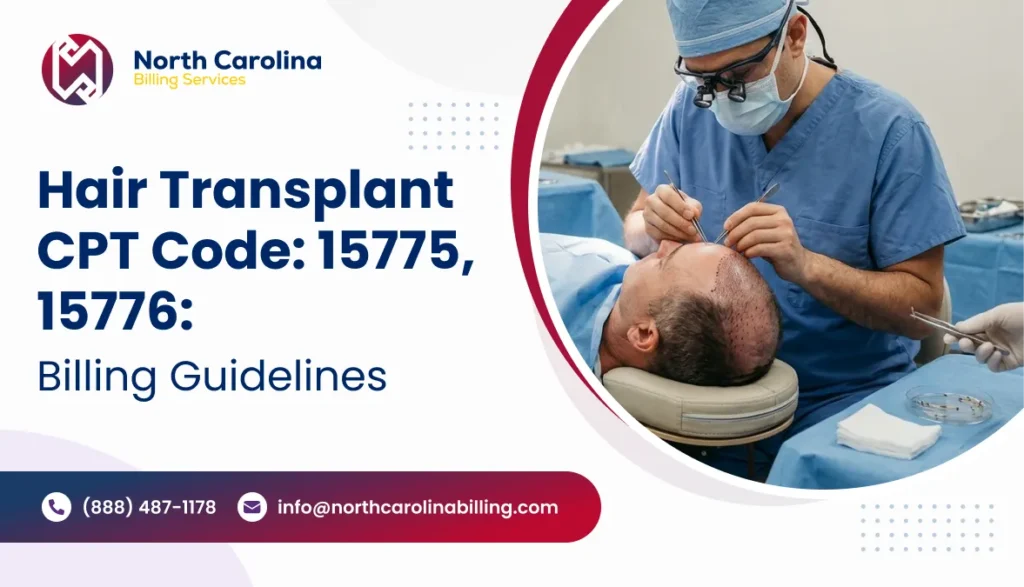
Hair transplant coding frequently presents two questions: What CPT code properly identifies the procedure? Will the patient’s insurance pay for the procedure?
The answer hinges on the grafting method, number of punch grafts performed, and other factors, such as clinical indications and payer criteria.
The two main hair transplant CPT codes are 15775 and 15776, which both refer to punch-graft transplants. But proper selection of the procedure code does not ensure medical necessity and insurability.
For plastic surgeons, dermatologists, and hair restoration specialists, accurate hair transplant coding starts with the operative report. This tutorial helps you understand the distinctions between CPT 15775 and 15776, code 21 punch grafts, know what documents to provide for your claim, and why insurers reject hair transplant procedures.
What Is the CPT Code for Hair Transplant?
CPT codes 15775 and 15776 represent hair transplantations done using punch grafts. According to the American Medical Association, these codes fall under surgical procedures that involve flaps and grafts.
The primary difference is the number of punch grafts performed during the procedure.
| CPT Code | Procedure description | Graft count |
| 15775 | Punch graft for hair transplant | 1–15 punch grafts |
| 15776 | Punch graft for hair transplant | More than 15 punch grafts |
These code descriptions appear in CPT reference terminology and procedure-coding resources.
For instance, if a doctor carries out 12 qualifying punch grafts, he will report CPT 15775. If a doctor carries out 21 qualifying punch grafts, then CPT 15776 will be the reported number of grafts.
Importantly, these codes specifically address punch-graft transplantation. They should not automatically apply to every hair restoration technique.
CPT Code 15775: Hair Transplant With 1–15 Punch Grafts
CPT code 15775 refers to the surgical technique of hair transplant that involves 1 to 15 punch grafts.
In punch graft surgery, the doctor removes the hair from the donor site and transfers the grafts to the recipient site where the person has lost hair. The operative report must mention the method as well as the number of grafts transplanted.
When should providers report CPT 15775?
Consider a patient undergoing a limited punch-graft procedure to address a small area of hair loss.
The physician documents:
- Punch-graft transplantation as a surgical technique.
- A total of 10 punch grafts were placed.
- The donor site and recipient site.
The indication for surgery and operative findings.
If the service satisfies the total definition of CPT code 15775, as well as the coding guidelines, CPT code 15775 would usually be considered the appropriate code.
It is important that the doctor does not choose this code based on the use of hair follicles alone.
CPT Code 15776: Hair Transplant With More Than 15 Punch Grafts
- CPT code 15776 includes hair transplantation by means of punch graft greater than 15.
- The numerical range for the number of grafts in the code starts from 16.
- Hence, cases with 16, 21 or 30 grafts qualify under the numerical range.
- The physician needs to document the exact number of grafts instead of merely noting the transfer of multiple grafts.
- Hair Transplant 21 Punch Grafts CPT Code
- The appropriate CPT code for a case with 21 punch grafts is 15776 if the technique described in the code is used by the physician.
- For instance, a patient underwent hair transplant through punch grafts in order to regrow hair in the injured scalp region.
- Documentation in the Operative Report was:
- The physician harvested hair-bearing punch grafts.
- The physician prepared the recipient site.
- The physician placed 21 punch grafts..
Because the documented punch-graft count exceeds 15, CPT 15776 represents the appropriate graft-count category.
As the number of punch-grafts performed is more than 15, it means that CPT 15776 will be the code used to report the right category of graft count.
There is a need to consider the above-mentioned criteria, such as the diagnosis, insurance benefits, and medical necessity, in order to make a decision about filing a claim.
Is CPT 15776 meant for all the grafts after the first 15?
No. CPT 15776 is not the add-on code for each additional punch graft.
It is meant for those cases where more than 15 punch grafts are done. It is not recommended to use CPT 15775 for the first 15 grafts and CPT 15776 for the rest of 6 grafts in a 21-graft surgery.
This information is stated by AMA in the historical RUC documentation of CPT 15776.
CPT 15775 vs. 15776: What Actually Changes?
The difference between these codes is straightforward, but errors can arise when the operative report lacks a clear graft count.
| Coding consideration | CPT 15775 | CPT 15776 |
| Surgical technique | Punch-graft hair transplantation | Punch-graft hair transplantation |
| Number of grafts | 1–15 | 16 or more |
| Documentation | Exact graft count and technique | Exact graft count and technique |
| Automatic insurance coverage | No | No |
| Principal coding concern | Confirm the smaller graft range | Confirm more than 15 grafts |
A surgical procedure using precisely 15 punch grafts is classified under CPT 15775. However, a surgical procedure using 16 punch grafts qualifies to be classified under CPT 15776.
Nevertheless, neither of these codes ensures payment just because the physician has documented the procedure correctly.
Does Hair Transplant Technique Affect CPT Code Selection?
Yes. The surgical technique matters just as much as the number of grafts.
Modern hair restoration clinics commonly perform follicular unit extraction (FUE) and follicular unit transplantation (FUT). Although both techniques relocate hair-bearing tissue, they differ in how surgeons harvest donor follicles.
Follicular Unit Extraction (FUE)
In FUE, the surgeon removes each follicular unit individually from the donor site and transfers it to the recipient area.
It is possible that FUE uses punch-type removal tools, but this does not mean that the procedure necessarily fulfills the criteria of CPT codes 15775 and 15776.
In choosing an appropriate code, the coder has to match the procedure with the CPT criteria.
Follicular Unit Transplantation (FUT)
Generally, FUT requires that a strip of hairy scalp skin be harvested, prepared as follicular units, and transplanted back to the desired treatment site.
As FUT employs a distinct process of harvesting, clinics cannot use CPT codes for punch grafts automatically by counting the number of follicular units transplanted.
If a defined CPT descriptor is unable to sufficiently describe the procedure performed, a qualified coder needs to consult the existing coding guidelines and any payer requirements rather than force the procedure into an irrelevant code.
ICD-10-CM Diagnosis Codes Associated With Hair Transplantation
Hair transplant CPT codes represent the procedure. ICD-10-CM codes represent the patient’s diagnosis or the reason for the visit.
Physicians need to mention the underlying disease and the rationale behind the treatment before coming up with a diagnosis.
| ICD-10-CM code | Description | Coding consideration |
| L64.9 | Androgenic alopecia, unspecified | When the physician documents androgenic alopecia without greater specificity |
| L65.9 | Nonscarring hair loss, unspecified | When the documented diagnosis supports unspecified nonscarring hair loss |
| Z41.1 | Encounter for cosmetic surgery | When the encounter primarily involves elective cosmetic surgery |
These diagnoses appear in the FY 2027 ICD-10-CM classification applicable to encounters from October 1, 2026, through September 30, 2027.
Why diagnosis selection matters
Assume a patient comes asking for hair transplant due to pattern baldness caused by hereditary factors.
The doctor makes notes about androgenic alopecia and advises transplantation on the grounds of improving the appearance of the patient.
While the medical notes contain information about the real hair loss problem, such diagnosis does not mean an automatic right for coverage of transplantation expenses.
The practice needs to separate the diagnosis from the purposes of performing the procedure. The appearance enhancement procedure can be considered cosmetic by the insurer.
At the same time, a patient who is required to reconstruct his or her scalp after an accident presents another case of medical necessity.
In any case, the provider needs to note the real medical condition rather than choose a diagnosis for getting better coverage.
Does Insurance Cover Hair Transplant Procedures?
Hair Transplantation does not always fall within the scope of an individual’s insurance coverage if one seeks out the treatment for cosmetic reasons.
Though Medicare typically does not cover any form of cosmetic surgeries, there are a few exceptions that are made for cases where accidents occur or a malformed body part needs to be fixed.
Private health plans may apply their own medical policies, exclusions, and benefit limitations.
Cosmetic vs. reconstructive hair transplantation
It can influence the way that practice deals with insurance verification and financial responsibility of the patient.
Cosmetic hair restoration
A patient wishes for transplantation because of the poor hair condition related to genetic hair loss.
The surgeon records the diagnosis and treatment procedure, but the procedure focuses mainly on the aesthetic condition of the patient.
In this case, the practice needs to be prepared for the possible cosmetic exclusion of the insurance contract and discuss the payment terms before the surgery.
Reconstructive hair restoration
A patient experiences hair loss of the scalp due to an accident. The physician examines the condition and prescribes transplantation as the treatment method.
The circumstances may warrant an individualized coverage review.
However, documentation of an injury does not, by itself, establish that a particular hair transplantation procedure meets the payer’s medical-necessity requirements.
What should practices verify before treatment?
In preparation for arranging an insurance-funded transplant, ensure that:
- Coverage of the procedure is included in the patient’s coverage.
- The coverage specifically excludes hair transplantation.
- Reconstructive reasons can be considered an exception.
- Prior authorization from the payer is required before proceeding.
- Which medical documentation will be needed to evaluate the claim.
Even when prior authorization is received, payment is not assured. The ultimate determination depends on the plan and its evaluation of the claim.
Documentation Requirements for Hair Transplant CPT Codes
A properly documented surgical record helps the physician substantiate the service and enables coders to choose the correct procedure code.
For punch-graft transplantation, the operative report should establish the procedure’s essential details.
1. Medical indication
Include the disease diagnosis, previous treatment if applicable, and the rationale for the surgical intervention.
In cases where the procedure could be reconstructive, state how the injury or the medical condition connects to the proposed procedure.
2. Procedure performed
List the exact surgical technique used.
Such information would include whether punch grafting, FUE, FUT, etc., was used. A statement like “Hair transplant done” would not be enough for procedure coding purposes.
3. Exact graft count
Record the actual number of qualifying punch grafts transferred.
A documented count of 21 punch grafts supports the numerical threshold for CPT 15776. A record stating only “multiple grafts placed” leaves that threshold uncertain.
Also distinguish grafts from individual hairs or follicles. These measurements are not necessarily interchangeable.
4. Donor and recipient sites
Identify the anatomical areas involved in graft harvesting and placement, including relevant operative findings.
5. Complete operative report
The physician should finalize, sign, and date the operative report according to applicable documentation requirements.
If the clinical record does not establish an essential detail, request clarification rather than making assumptions.
Common Hair Transplant Billing Errors and How to Avoid Them
Hair restoration claims can encounter problems even when the procedure itself was performed correctly.
The following errors deserve particular attention.
| Common error | Potential consequence | Recommended action |
| Reporting 15775 for 21 punch grafts | Incorrect procedure classification | Verify the graft count and use the applicable CPT descriptor |
| Reporting both 15775 and 15776 for one procedure | Duplicate or unsupported reporting | Review the code structure before submission |
| Applying punch-graft codes to every FUE or FUT procedure | Technique-to-code mismatch | Review the operative method and CPT instructions |
| Treating a cosmetic diagnosis as proof of coverage | Noncovered-service denial | Check the member’s actual benefits |
| Missing operative details | Insufficient documentation | Obtain a completed, specific operative report |
| Assuming prior authorization guarantees payment | Unexpected reimbursement problems | Verify all remaining claim and benefit requirements |
Approach to denied cosmetic services
A cosmetic service rejection should be analyzed in depth before filing another claim.
For instance, when an insurer rejects a hair restoration procedure due to its contractual exclusion from coverage as a cosmetic procedure, just changing the diagnosis code without clinical substantiation will not help with addressing the issue.
One should look at the language of the benefit plan, review medical records, authorization documents, and remittance advice.
If the denial is due to a factual or administrative mistake, the practice can try correction or appeal depending on the payer’s policies.
If the patient’s policy does not cover the procedure, then the appeal might be of no avail to change the contractual exclusion.
Modifiers for Medicare
Choosing modifiers for Medicare claims requires special attention.
According to CMS, the appropriate modifiers for statutorily excluded and non-Medicare benefit services include modifier GY. In case a provider provides voluntary notice of liability, modifier GX should be used.
However, the process of providing an Advance Beneficiary Notice of Noncoverage (ABN) and voluntary notice of liability for a statutorily excluded service differs greatly.
Thus, practices should not use automatic modifiers GA, GX, GY, or GZ for all hair transplant procedures.
How Healthcare Practices Can Improve Hair Transplant Billing Accuracy
The most effective billing improvements begin before the procedure.
Start with the surgical plan. Confirm whether the physician intends to perform punch grafting or another transplantation technique.
Verify the insurance policy. A patient may have active health insurance but no benefits for elective cosmetic hair restoration.
Establish financial expectations. When a procedure is self-pay, provide clear estimates, explain payment obligations, and obtain appropriate financial acknowledgments before treatment.
Audit the operative report. Compare the documented surgical method and graft count with the proposed CPT code.
Review claim requirements. For potentially covered services, confirm the diagnosis, medical-necessity documentation, payer policy, and any authorization requirements.
Track denials by cause. Separate cosmetic exclusions from coding errors, missing information, and authorization failures. Each problem calls for a different response.
For medical practices, these steps reduce preventable administrative work and help patients understand their financial responsibilities.
Frequently Asked Questions About Hair Transplant CPT Codes
1. What is the CPT code for a hair transplant?
CPT 15775 and 15776 describe punch-graft hair transplantation. CPT 15775 applies to 1–15 punch grafts, while CPT 15776 applies to more than 15. The appropriate code depends on the physician’s documentation and actual procedure.
2. What is the CPT code for hair transplant with 21 punch grafts?
CPT 15776 is the applicable code for 21 qualifying punch grafts because the documented number exceeds 15. Insurance reimbursement still depends on coverage and medical-necessity requirements.
3. What is CPT code 15775 used for?
CPT 15775 describes punch-graft hair transplantation involving 1 to 15 grafts. Physicians must document the surgical technique and actual graft count.
4. What is the difference between CPT 15775 and 15776?
The principal difference is graft quantity. CPT 15775 covers 1–15 punch grafts, while CPT 15776 describes more than 15 punch grafts.
5. Can physicians bill CPT 15775 and 15776 together?
Providers generally should not report both codes simply to divide a single punch-graft procedure into its first 15 grafts and additional grafts. CPT 15776 already represents the more-than-15 category.
6. Is hair transplantation covered by Medicare?
Medicare generally excludes elective cosmetic surgery. Certain reconstructive circumstances may qualify for consideration under applicable coverage rules, but physicians should not assume that an injury-related hair transplant will automatically receive payment.
7. Can CPT 15776 be used for FUE hair transplantation?
Not automatically. FUE uses a follicular-unit extraction approach, and the presence of a punch-shaped instrument does not independently establish that the completed procedure meets CPT 15776. Coders should evaluate the complete surgical technique.
8. Which ICD-10-CM code should accompany a hair transplant claim?
The diagnosis must reflect the physician’s documented findings and purpose of treatment. Examples include L64.9 for androgenic alopecia, L65.9 for unspecified nonscarring hair loss, and Z41.1 for a cosmetic surgery encounter. No single diagnosis guarantees coverage.
Conclusion
Accurate hair transplant coding requires more than counting grafts. CPT 15775 describes 1–15 punch grafts, while CPT 15776 describes more than 15. For a procedure involving 21 qualifying punch grafts, CPT 15776 represents the applicable graft-count category.
However, physicians and practice administrators must also confirm the surgical technique, document the treatment purpose, and verify insurance coverage before submitting claims. By addressing these details early, hair restoration clinics can reduce coding discrepancies, avoid unnecessary claim corrections, and communicate treatment costs more clearly.
Simplify Hair Transplant Billing With Expert Support
Hair restoration clinics face specific coding and coverage challenges, from documenting punch-graft procedures to verifying cosmetic surgery exclusions. Professional medical billing support can help your practice review coding accuracy, manage claims, and reduce avoidable administrative errors.