

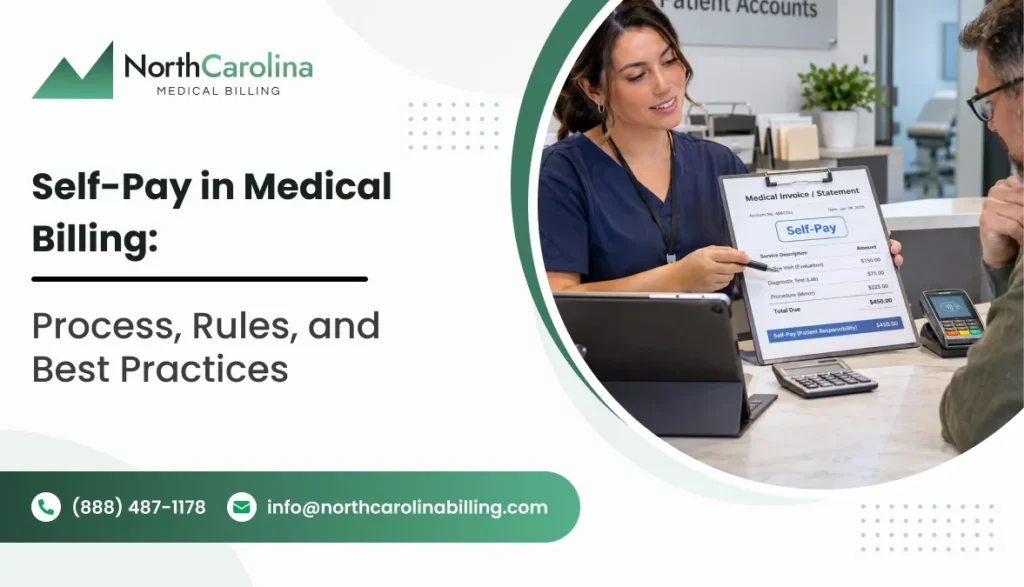
In some cases, patients will be unable to pay for treatment via insurance. This may be because they have no insurance, choose not to use their insurance, or the service provided is not covered by their insurance policy. Regardless, this patient visit should be documented, charged appropriately and clear information provided to the patient on how much they are liable to pay. This creates a self-paying account.
Self-paying refers to a patient being directly responsible for paying for healthcare treatment. The practice will manage patient information, estimating costs, recording charges, collecting payments, producing invoices and managing outstanding payment from the patient, without claiming reimbursement from insurance.
As well as collecting payments from patients, staff within your billing department must know what the patient owes, any federal regulations, what documentation codes to use, how to manage payment agreements, and how to manage accounts receivable.
Efficient self-paying processes for your practice will help provide clarity on costs to patients, reduce confusion and give more control over the revenue cycle.
What Is Self-Pay in Medical Billing?
A self-pay claim means that the patient is paying for the service in full out of pocket.
- Patients can be self-pay because:
- They do not have cover.
- They choose to pay out of pocket.
- The service is not covered by the patient’s insurance network (and they are choosing to pay out of pocket, subject to applicable rules).
Please be careful not to confuse self pay patients with those who have insurance but who owe money (co-payment / deductible).
Patients having a positive balance in their deductibles may not be self pay patients. It must be assessed whether this claim should be sent to insurance. If it should not be sent to insurance, it should then be assessed whether the amount owed should be charged to the patient.
It is important to note that good faith estimate protections at federal level generally only apply to uninsured individuals or insured individuals who have chosen not to make a claim. Patients on Medicare / Medicaid who wish not to use their insurance do not automatically qualify for protections.
Why Does Self-Pay Billing Matter to Medical Practices?
Billing to self pay patients is very different. You can no longer rely on insurance companies to determine what they should pay.
As such, the billable amount will have to be discussed directly with the patient.
There are three key considerations.
Helps patients understand costs
Ensure that patients understand what the service will cost them, any payment timelines, discounts and support available.
This helps avoid issues with unexpected balance due.
Improves overall revenue cycle
If statements are delayed, reminders missed or payment plans not recorded, it is easy for balances to get out of control.
A well run self pay billing system allows for more transparency within your practice around patient balances and receivables.
Compliance
Some providers/locations must provide Good Faith Estimates for uninsured/self pay patients according to Federal Regulations.
Under the No Surprises Act, eligible patients may be able to raise a dispute with their provider if they are sent a bill which is significantly more than what was estimated.
These should be considered within your practice process for booking patients, billing and patient communications.
How Does the Self-Pay Billing Process Work?
Helps patients understand costs
Ensure that patients understand what the service will cost them, any payment timelines, discounts and support available.
- This helps avoid issues with unexpected balance due.
- Improves overall revenue cycle
- If statements are delayed, reminders missed or payment plans not recorded, it is easy for balances to get out of control.
- A well run self pay billing system allows for more transparency within your practice around patient balances and receivables.
- Compliance
- Some providers/locations must provide Good Faith Estimates for uninsured/self pay patients according to Federal Regulations.
- Under the No Surprises Act, eligible patients may be able to raise a dispute with their provider if they are sent a bill which is significantly more than what was estimated.
- These should be considered within your practice process for booking patients, billing and patient communications.
Example of a Self-Pay Billing Scenario
A patient has attended a non-insurance funded out-patient appointment.
The practice gives an estimate to the patient (in this case $200). Once the patient has attended their appointment, the provider inputs the notes of the consultation. The charges for the service are also input by the billing team.
The patient pays $100. In the billing system, this will be added as a payment. This leaves a patient debt of $100.
An itemised bill is sent to the patient and the payment policy within the practice is followed.
Even though no claims have been sent to the insurer, correct charging, recording payments and keeping a record of patient debts is very important.
Good Faith Estimates and the No Surprises Act
Good Faith Estimate
Generally, providers and facilities must give uninsured/self pay patients with a Good Faith Estimate of expected costs if requested or if they are scheduling qualifying services at least 3 business days in advance under the No Surprises Act.
This estimate should detail what is expected to be charged for the healthcare being received.
In general, estimates should be given within the following timescales:
| Scheduling timeframe | GFE delivery deadline |
| 3–9 business days before care | Within 1 business day of scheduling |
| 10 or more business days before care | Within 3 business days of scheduling |
| Patient requests an estimate without scheduling | Within 3 business days of the request |
No advance estimate requirement applies.
Dispute process
Eligible uninsured/self pay patients can use the Patient Provider Dispute Resolution (PPDR) process if they have a bill from a provider that is $400 or more than their Good Faith Estimate. As with all processes there are eligibility and submission criteria. Patients can generally raise a dispute within 120 calendar days after the original bill.
Record estimates, notes of communication with patients and compare final charges to estimates.
Read the official CMS Good Faith Estimate guidance for additional details.
Medical Coding Considerations for Self-Pay Patients
If a practice is self-paying, it is still important that you correctly record the services provided.
CPT and HCPCS Codes
CPT and HCPCS Level II codes are used to describe services, procedures, products and other items provided within healthcare.
In an example, if a patient has seen you in an Outpatient clinic setting, you would include an appropriate Evaluation and Management (E/M) code in the claim, depending on the service provided and the coding guidelines.
Codes within claims should be applied based on the services provided and not due to what a patient is willing to pay for.
ICD-10-CM Diagnostic codes
ICD-10-CM codes allow practitioners to record the diagnosis, symptoms and appropriate conditions suffered by patients.
Accurate diagnostic coding supports good record keeping within the practice, clinical reporting and internal billing. You must never apply a diagnosis to support charging a specific cost.
Charge Entry and Documentation
Check list:
- Provider information
- Correct CPT or HCPCS codes
- Correct ICD-10-CM codes
- Correct modifiers
- Correct POS
- Correct fee schedule and price
- Payment history and adjustments
Note: This is a self pay so it must be checked that it is not being considered as insurance. CPT, HCPCS and ICD-10-CM codes can be used for documentation and detailed billing but do not mean it will be reimbursed by insurance. It also does not guarantee that the service will be paid at the specified rate.
Common Self-Pay Medical Billing Problems
Even experienced billing teams encounter problems when they manage patient-direct payments.
| Common problem | Impact on the practice | Recommended solution |
| Incorrect patient classification | Creates billing and compliance confusion | Confirm insurance status and payment intentions |
| Missing Good Faith Estimate | Creates regulatory exposure | Build GFE checks into scheduling |
| Unclear service pricing | Leads to patient disputes | Communicate expected charges in advance |
| Incorrect charge entry | Produces inaccurate statements | Review documentation before posting charges |
| Delayed patient statements | Slows payment collection | Establish a consistent billing schedule |
| Poor payment tracking | Creates inaccurate AR balances | Reconcile payments regularly |
| Weak follow-up procedures | Leaves balances unresolved | Use documented collection workflows |
Best Practices to Improve Self-Pay Patient Collections
Ensure good handling of self pay accounts
Give clear information on costs. Include details about payment types, refunds and payment plans in advance.
Give clear cost information. Provide cost estimates in an easy to understand format. Remember that these are estimates.
Provide easy payment methods. Allow patients to pay using Credit/Debit card, online payment and payment schemes.
Review self pay accounts. Check the aged analysis regularly to see which patients have not paid and follow up appropriately.
Staff training. Train staff in reception and accounts. Ensure that they know how to register patients, provide a Good Faith Estimate, post payments and document.
Accurate financial recording. Ensure that payments from patients, adjustments, refunds and arrears are accurately recorded in the practice system.
Seek expert support. Billing experts can be employed in a practice to ensure charge entry, issuing patient statements, posting payments, following up on accounts and documenting billing is done well.
When Should a Practice Consider Self-Pay Medical Billing Services?
Managing self paying accounts can add increased administration.
If the practice is struggling to manage self paying accounts, a medical billing support service could help. This includes:
- Maintaining accurate patient account information.
- Producing accurate billing documents.
- Accurately processing payments.
- Consistently following up.
- Checking accuracy of charges and coding.
- Organizing financial documents.
- Tracking performance on money owed by patients.
Working with an experienced medical billing provider can allow consistent working processes to be established and may help ease the administrative burden. The provider however has responsibility for any regulatory requirements and ensuring accurate clinical documentation.
Frequently Asked Questions
1. What does self-pay mean?
Charges incurred by patients which are paid by the patient directly. This can apply to both patients who do not have insurance, and for patients who do have insurance, however choose not to claim for eligible services.
2. Process
Register patients, confirm insurance status. Calculate costs, give Good Faith Estimates (if applicable), Record treatment, Charge, Collect payments, and follow up for any unpaid balances.
3. Do patients who pay-self have to be given a Good Faith Estimate?
Yes, in general. If a patient is eligible and either uninsured or paying self-pay, a provider or facility should give them a Good Faith Estimate if requested or if they have made an appointment for eligible services 3 working days in advance. Beneficiaries of Federal Healthcare Programs such as Medicare and Medicaid are not eligible for a GFE.
4. Can discounts be offered to self-pay patients?
Discounts may be applied to self-pay services. However, it must be considered if the practice is compliant with any governing legislation at Federal and State levels, and if discounts comply with agreements with payers and any programmes. Particular consideration must be given to rules within Medicare and other Government programs.
5. Are CPT and ICD-10-CM codes required for self-pay patients?
CPT, HCPCS and ICD-10-CM codes may be used in relation to self pay patients to record treatments, diagnosis, produce detailed billing information, and ensure correct billing. The correct coding will depend upon the documentation provided by the provider, and what coding guidelines apply.
6. What is the difference between self pay and patient liability?
Self pay is when charges are agreed to be paid directly by a patient. Patient liability relates to the amount owed by the patient for claims processed through insurance. This would include amounts due via deductibles, co-pays and co-insurance.
7. How can I improve collection of self pay balances?
Improved collection can be achieved by providing clear estimates, clear payment policies, taking the correct payments during the service, sending bills in a timely manner, offering payment options, and regularly reviewing your accounts receivable.
NORTH CAROLINA MEDICAL BILLING
Need Reliable Self-Pay Medical Billing Support?
Managing self-pay patients, outstanding balances, and payment collections can put extra pressure on your medical practice. North Carolina Medical Billing helps healthcare providers streamline patient billing, manage accounts receivable, and maintain accurate payment records.