

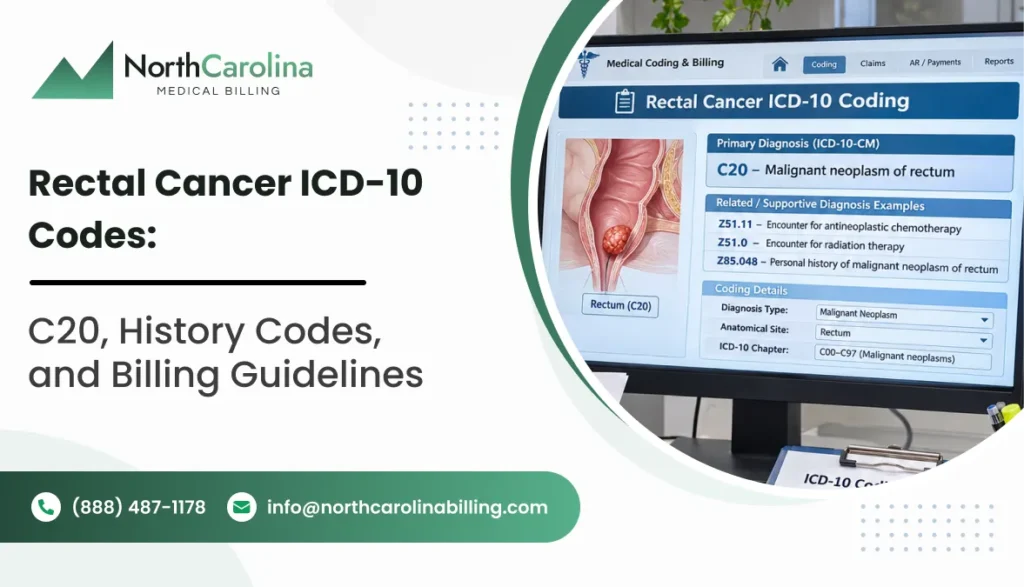
Selection of appropriate ICD-10 codes for rectal cancer involves more than just a confirmation of a cancer diagnosis. One has to distinguish whether there is an active cancer or one that had been treated before, determine the location of the tumor, and specify the reason for each visit.
ICD-10 code C20 represents malignant neoplasm of rectum, whereas Z85.048 represents a personal history of previous treatment of non-carcinoid rectal cancer.
Such differentiation affects the sequencing of the diagnosis, claims processing of oncology, and medical necessity for surveillance services.
This cheat sheet provides information on ICD-10-CM codes for rectal cancer, cancer history requirements, coding examples, and billing tips according to the FY2027 guidelines.
What Is the ICD-10 Code for Rectal Cancer?
The ICD-10-CM code for primary malignant neoplasm of the rectum is C20. When clinical documentation supports the diagnosis of primary rectal malignancy, coders assign this code.
A patient’s medical history of cancer treatment and the location of the tumor can necessitate different codes.
| ICD-10-CM | Description | Typical use |
| C20 | Malignant neoplasm of rectum | Active primary rectal cancer |
| C19 | Malignant neoplasm of rectosigmoid junction | Active cancer at the rectosigmoid junction |
| Z85.048 | Personal history of other malignant neoplasm of rectum, rectosigmoid junction, and anus | Previously treated non-carcinoid malignancy |
| Z85.040 | Personal history of malignant carcinoid tumor of rectum | Previously treated rectal carcinoid malignancy |
| Z80.0 | Family history of malignant neoplasm of digestive organs | Relevant family history of rectal cancer |
| Z08 | Encounter for follow-up examination after completed treatment for malignant neoplasm | Qualifying post-treatment surveillance encounter |
| D01.2 | Carcinoma in situ of rectum | Documented rectal carcinoma in situ |
The CMS ICD-10-CM resources provide the official FY2027 code files and guidelines, effective October 1, 2026, through September 30, 2027.
Why Accurate Rectal Cancer Coding Matters
The American Cancer Society’s 2026 estimates project approximately 49,990 new rectal cancer cases in the United States in 2026.
For oncology practices, there are specific documentation and coding considerations with each stage of cancer management.
An active cancer diagnosis may be used to justify treatment procedures, whereas a complete history of treatment may justify surveillance properly documented. In either case, it does not ensure that all procedures would be covered.
Incorrect choice of diagnosis would result in:
Denied medical necessity due to the inability of diagnosis codes to support a particular procedure.
- Claim edits as a consequence of inconsistent cancer status or sequence of diagnoses.
- Incorrect information about follow-up and surveillance claims.
- More documentation requests by the payer.
- Delay in payments and additional accounts receivable work.
The most critical differentiation is that of active rectal cancer and personal history of rectal cancer.
ICD-10 Code C20: Malignant Neoplasm of Rectum
The code C20 is used for the identification of the presence of an active primary malignancy in the rectum.
A primary rectal adenocarcinoma can be coded or any other type of malignant neoplasm in the rectum can be coded under this code.
When Should Providers Report C20?
Clinical documentation can establish C20 if:
- There is a documented presence of active rectal malignancy.
- The patient undergoes a treatment for the primary rectal malignancy.
- The tumor is surgically removed, but further treatment for the primary malignancy persists.
- Persistent or recurrent rectal malignancy is documented.
According to the guidelines of ICD-10-CM, there should be a continued use of the primary malignancy code if the patient still undergoes treatment targeting the primary malignancy even after surgical removal.
Does C20 Identify the Cancer Stage?
No. C20 represents the location of the malignancy, not the clinical staging of the cancer.
Clinical staging at II, III, or IV does not necessarily mean that you use a different code for rectal cancer.
For metastatic cases, the coder should check documentation to determine the secondary malignancy codes.
ICD-10 Code for Personal History of Rectal Cancer
For the personal history of rectal cancer, the ICD-10 code is usually coded to Z85.048 when a patient has had a non-carcinoid rectal tumor before and satisfies the requirements for history coding.
Z85.048 refers to personal history of other malignant neoplasms of the rectum, rectosigmoid junction, and anus.
It is advisable that the physician codes Z85.048 when the patient’s medical record shows progression from active malignancy to personal history.
When Does Rectal Cancer Become a History Code?
For the fiscal year 2027 ICD-10-CM coding, there are three essential criteria:
- There is no longer any indication of the presence of the primary malignancy at its primary site.
- There is an indication that the patient has successfully finished treatment for that specific primary site.
- The original primary malignancy has been either excised or eradicated.
If all three criteria have been met, then usually the coder uses the personal history code instead of the primary malignancy code.
Example: The patient had rectal cancer resection surgery and is now attending surveillance appointments without having any primary disease.
This situation may indicate the use of Z85.048 along with the corresponding encounter code if applicable.
What If Treatment Continues After Surgery?
Just because surgery is performed does not necessarily mean that the history code is justified.
As long as the oncology group continues the treatment of the primary rectal cancer by means of chemotherapy, radiation, etc., the necessary guidelines might demand the report of the code indicating the active cancer.
Examine the treatment regimen and disease status and speak with your oncologist prior to modifying C20 to Z85.048.
ICD-10 Code for Family History of Rectal Cancer
The ICD-10 code used for family history of rectal cancer is Z80.0, representing family history of malignant neoplasm of digestive organs.
Z80.0 refers to any history of cancer within the patient’s family. This code does not confirm that the patient has been diagnosed with rectal cancer.
For instance, a doctor may report a history where the parent of the patient has been diagnosed with rectal cancer. If such history has an impact on the encounter, then it can be supported by the use of Z80.0 code.
Coders should ensure that they differentiate family history from genetic cancers and other diseases.
Personal History vs. Family History
| Documentation | Code | Key distinction |
| Patient currently has primary rectal cancer | C20 | Active malignancy |
| Patient previously had qualifying non-carcinoid rectal cancer | Z85.048 | Personal history |
| Patient previously had malignant rectal carcinoid tumor | Z85.040 | Specific personal history |
| Patient has a relative with rectal cancer | Z80.0 | Family history |
A family member’s diagnosis never establishes an active cancer diagnosis for the patient.
2027 ICD-10-CM Diagnosis Code+1
ICD-10 Code for Hx of Rectal Cancer
The medical record will usually abbreviate patient history as Hx.
In cases where “Hx of rectal cancer” is recorded, it is the responsibility of the coder to decide whether the wording implies that the condition is a cured cancer or an incomplete history of cancer.
The most appropriate history code for a non-carcinoid malignancy will usually be Z85.048.
An abbreviation is not always enough to establish whether treatment was completed or whether there is currently any cancer.
Rectal Cancer Follow-Up and Surveillance Coding
- Follow-up visits establish a consistent difference between active treatment and follow-up after treatment.
- Z08: Follow-Up After Completed Cancer Treatment
- Z08 is the ICD-10-CM code for a follow-up examination after completed cancer treatment.
- If the visit fits the criteria of follow-up, coders should code Z08 as the primary diagnosis along with the personal history code.
- The two together may be used for the patient with a history of treated noncarcinoid rectal cancer as follows:
- Z08: Follow-up examination after completed cancer treatment.
- Z85.048: Personal history of other malignant neoplasm of rectum, rectosigmoid junction, and anus.
The FY2027 ICD-10-CM Official Guidelines explain the distinction between follow-up examinations and ongoing aftercare.
Surveillance vs. Diagnostic Evaluation
A cancer follow-up visit is unlike an appointment where the physician is looking into the cause of rectal bleeding, imaging findings, or a potential recurrence.
Diagnoses codes are chosen depending on the rationale behind the service and findings.
Z08 must never be coded when the physician is examining or managing a newly presented problem or disease condition.
Rectal Cancer Coding Examples for Medical Practices
SCENARIO 01
Active rectal adenocarcinoma
The patient has confirmed primary rectal adenocarcinoma, documented by a gastroenterologist and referred to oncology.
Code: C20, if the documentation of an active primary rectal malignancy is supported.
SCENARIO 02
Nonactive previously treated rectal cancer
The patient has completed treatment of their noncarcinoid rectal cancer. No evidence of remaining primary disease is found by the oncologist.
Code: Z85.048 may apply to the patient’s personal history of cancer.
SCENARIO 03
Post-treatment follow-up visit
A doctor performs a qualifying follow-up visit after the patient has been successfully treated for cancer.
Codes: Z08, followed by Z85.048, as needed.
SCENARIO 04
Family history
The patient receives preventive care visit and states that his/her mother had rectal cancer.
Code: Z80.0, which describes the family history.
This is how a proper choice of a diagnosis is done and not a guarantee of payment.
Common Rectal Cancer Coding Errors and How to Avoid Them
Even experienced billing teams can encounter documentation gaps when cancer status changes between encounters.
| Coding error | Recommended correction |
| Reporting C20 after treatment completion without evidence of active primary disease | Verify whether the record supports a personal-history code. |
| Reporting Z85.048 while treatment directed at the primary malignancy continues | Review the oncology treatment plan and current diagnosis. |
| Confusing rectal cancer with rectosigmoid cancer | Confirm the documented primary tumor location. |
| Using Z85.048 for malignant rectal carcinoid history | Review the more specific Z85.040 code. |
| Assigning a history code for suspected recurrence | Obtain documentation of the current findings and clinical assessment. |
| Coding a family history as the patient’s malignancy | Confirm whose cancer diagnosis the record describes. |
Rectal Cancer Claim Review Checklist
Prior to filing oncology or associated gastroenterology claims, ensure that:
- The physician indicates the site of the primary tumor.
- The diagnosis indicates active disease or a history that qualifies.
- The medical record indicates treatment status currently.
- The physician indicates any metastasis documentation.
- The order of the diagnoses matches the purpose of the encounter.
- The codes selected are consistent with the appropriate code set.
- The procedure and diagnoses support the service provided.
How Professional Medical Billing Support Helps Oncology Practices
Rectal cancer claims will typically have more than one provider, facility, stages of treatment, and insurance companies involved. This results in possibilities for inconsistent diagnosis coding and prolonged claim settlement periods.
A professional medical billing team can assist your practice in all of the following:
Diagnosis verification: Checking active malignancy, personal history, and follow up codes.
Claim submission: Matching documentation to diagnosis codes and claim information.
Claim denial management: Researching denial reasons related to diagnosis codes.
Insurance verification: Ensuring coverage and necessary insurance authorization.
A/R management: Managing unpaid claims and addressing payer issues.
Effective communication among providers, coders, and billers is crucial for the accurate management of rectal cancer claims.
Frequently Asked Questions
1. What is the ICD-10 code for rectal cancer?
C20 refers to malignant neoplasm of rectum. The coder must ensure the anatomic site of the neoplasm and its malignant nature are both confirmed through documentation.
2. What is the ICD-10 code for the history of rectal cancer?
Z85.048 refers to personal history of rectal cancer when not carcinoid where the documentation supports the history code.
3. What is the ICD-10 code for personal history of rectal cancer?
Z85.048 is used for personal history of other previously treated malignant neoplasms of rectum, rectosigmoid junction, and anus. Z85.040 is used for malignant carcinoid tumor of rectum.
4. What is the ICD-10 code for family history of rectal cancer?
Z80.0 represents a family history of malignant neoplasm of digestive organs and does not imply the presence of cancer in the patient.
5. Can physicians use C20 for post-rectal cancer surgery?
Yes, if further therapy is directed at primary rectal malignancy or the physician indicates active primary disease despite the surgery performed.
6. What ICD-10 code is used for follow-up of rectal cancer?
Z08 can be applied to a follow-up visit after successful treatment of malignancy. Personal history code may be added in case it is applicable.
7. Is there an ICD-10 code for stage IV rectal cancer?
No. Stage does not influence the code selection of primary rectal malignancy. Confirmed metastatic sites should be coded additionally according to the coding conventions.
Conclusion
The correct coding for rectal cancer depends on three questions: The origin of the cancer, whether the patient is still actively suffering from the condition, and the reason for which the physician is providing the service.
C20, Z85.048, and Z80.0 are meant to be used differently. In order to choose between these codes, one needs proper documentation of the cancer condition and its history.
Practices that make sure their diagnoses are properly documented can avoid unnecessary medical bill errors.